Chaos As A Service March 13, 2009
Posted by Chuck Musciano in Leadership.Tags: Chaos, Leadership, Software, Software As A Service, Technology
2 comments
I recently worried about the potential disconnect between users seeking the latest technology and IT leaders being able to successfully assist them in finding that technology. If we don’t gain the trust of users before they start buying solutions, they’ll acquire things that will hurt our companies and drive IT staff to distraction. This all happens with the best of intentions, but is a disaster nonetheless.
Traditionally, buying technology solutions was a complicated affair. Not only did you have to buy software, you usually had to buy the servers and infrastructure that would host that software. The complexity of the purchase invariably allowed IT to get involved before the purchase was a done deal. If nothing else, the size of the purchase would raise flags, and the integration of the solution involved a call to someone, somewhere, who would know how to run the system.
With the arrival of Software As A Service (Saas), technology acquisition is frighteningly simple. The infrastructure is hosted in the cloud, so users need not worry about buying heavy iron to run their new applications. The pricing is typically by the month and builds incrementally, so that the initial outlay is so low that no one notices. Most of these apps run within a browser, so users are up and running quickly.
Proponents of Saas point to these features as the core value of Saas. No longer shackled by the restrictive concerns of centralized IT organizations, users are free to find and buy whatever tools suit their needs. This makes users more effective and efficient, and we all benefit. Right?
Wrong! Unbeknownst to the user community, there is a method to the madness of a good IT shop. Believe it or not, people spend a lot of time making sure that all these tools and systems work together and share information to maximize their value. They also worry about tiny details like backups, security, business continuity, and disaster recovery. In some cases, annoying distractions like the SEC and government regulations affect how we integrate and manage systems.
When many users independently acquire many tools, the ability to integrate and manage those tools effectively disappears. While you may achieve some local optimization for a small group of users, you have eliminated any ability to achieve enterprise-wide integration and sharing. The value in our information systems is ensuring that accurate, complete information is delivered to the right person at the right time. If that information is smeared across independent external systems, tying it all back together is simply impossible.
Unfortunately, Saas is sold like snake oil to unsuspecting end users. Before anyone knows what has happened, users can go to a web site, sign up for a service, and start using it. Once entrenched, that service is hard to eliminate or replace, and IT plays catch-up trying to extract and integrate the data in the system with the rest of the company. The cost is enormous and the user irritation is high.
Don’t misunderstand: Saas has value and can provide a cost-effective way to outsource part or all of your IT infrastructure. But the acquisition of Saas solutions is no different from a traditional system running on your own servers. It must integrate and comply with your strategic enterprise architecture, along with all your policies on disaster recovery, security, document retention, etc. Appropriate IT scrutiny of Saas before the purchase leads to clean integration and happy users.
How do you make this happen? The same way every IT success occurs: good communication with users that builds trust and natural partnerships to find solutions. Start talking and serving users now, and you’ll avoid chaotic Saas acquisitions later.
Right Or Wrong? Well or Poorly? March 2, 2009
Posted by Chuck Musciano in Leadership.Tags: Best Of 2009, Governance, Leadership, Management Skills, Project Management
5 comments
In a previous life, my boss had this chart hanging on his wall:
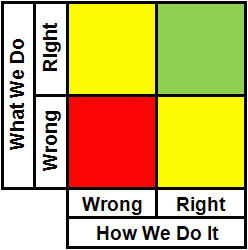
Pretty straightforward: everything can be placed in one of these four quadrants. We are either doing the right things or the wrong things. We are either doing them well or poorly. In contrast to all the complicated governance models that are being bandied about these days, this is a simple way to run your IT shop, your business, and your life.
As an eye-opening exercise, take all the major business processes in your company and place them in this grid. We all like to think that we live in the upper right, doing the right things the right way. In reality, way too much of our world is in the lower left. Every business has outdated business practices, ancient processes, and needless bureaucratic overhead, firmly entrenched in horrifically bad tools and mechanisms.
It is not hard to find these “red” processes and set out to fix them. Ideally, we seek to push them to the up and to the right, into the land of “green” processes: the right things, done right. More often than not, we wind up just moving to the right, or just moving up. That’s certainly a better spot, but only as a resting point, not as a final destination.
Doing the wrong things right is often known as “paving cowpaths.” Some awful business processes are so entrenched that they cannot be rooted out. Discretion being the better part of valor, we choose to automate bad processes, throwing good technology at a bad system. Life does get better, but you’re still left with a bad process.
Doing the right things wrong is a little better. By eliminating the bad process, you’re much better positioned to ultimately do the right thing the right way. If you wind up stalled on the way to the upper right, I’d rather be in the “right things wrong” world instead of the “wrong things right” world.
It’s easy to understand why. Technology is easy; people are hard. The worst part of our jobs is the social engineering: getting people to change their ways, adopt new practices, and learn new tools. Actually installing a new system can be a pain, but it can be done. People, with their delightful quirky personalities, pose real challenges to change and growth. If you move a process to the right, you’re still stuck with the difficult people problem. If you move a process up, you’ve solved the people problem and are left with the simpler technology concerns.
It is often said that managers get things done right, while leaders get the right things done. On our chart, good managers push things to the right. Good leaders push things up. Are you a manager or a leader? Which way are you pushing?
Why Are You Here? February 27, 2009
Posted by Chuck Musciano in Leadership.Tags: Coaching, Leadership, Mentor
3 comments
One of favorite quotes is from Ashleigh Brilliant:
It could be that the purpose of your life is only to serve as a warning to others.
This quote has been immortalized in one of the delightful Demotivator posters, many of which I find endlessly amusing. Amusing or not, these posters provide many good lessons in leadership in a very backhanded way.
In a recent email exchange, I was reminded that although I have learned a lot from several good leaders for whom I worked, I usually learned the most from the very bad leaders under whom I suffered. Some people can share heartwarming stories of good leaders whose words and actions served to inspire them. Everyone can recount endless stories of incredible abuse from thoughtless fools who were somehow given a leadership role in spite of their clear sociopathic tendencies.
I worked for one person who honestly epitomized every bad leadership quality you could imagine. He punished in public and praised in private. He never communicated. His ego knew no bounds. He sold out his people for his own gain. He took credit when things went well and threw us under the bus when they went badly. He would change projects, schedules, plans, and goals at the drop of a hat. Even when confronted with direct feedback in a group review, he simply ignored it and thanked everyone for their honesty. He was, in short, an idiot of spectacular dimension.
With each error, each annoyance, each dig and snub, I added to my mental list of “things I will never do when I am in charge.” I came away with more ideas on how to be a good leader than I ever thought possible.
It’s a sad fact of human nature that we often remember punishment more than praise. Eat bad food once and you’ll never touch it again, but the memories of a good meal do fade with time.
Don’t misunderstand: I am not suggesting that you “speed mentor” your team with a bout of bad leadership. Continue to be a good leader, but with the knowledge that those lessons will take a longer time to sink in. Most importantly, avoid even a single example of bad leadership, because that negative experience will never be forgotten.
To open up the conversation a bit, what good bit of leadership do you remember? More interestingly, what’s the worst leadership example you retain on your list of “things you’ll never do as a leader?”
Staying Out Of Holes February 18, 2009
Posted by Chuck Musciano in Leadership.Tags: Computing, Leadership, Software, Users
1 comment so far
Since the dawn of computing, we’ve worked really hard to make technology easier and more accessible. Computers started out in protected data centers, with mere mortals kept far, far away from actually using the machines. Today, we’ve pushed powerful tools into the hands of end users that enable them to do all sorts of amazing things on a regular basis.
As users become more comfortable with these tools, they try to acquire more of them. That’s a great thing, until those well-meaning end users get in over their heads and wind up holding a technology tiger by the tail.
Let’s be honest: computers, especially enterprise computing systems, are inordinately complicated. They are not easy to buy, install, configure, or maintain. It takes a a team of experienced professionals to make sure that a company buys the right systems, deploys them correctly, and maintains them for maximum business advantage. When end users try to take that on themselves, disaster invariably ensues.
Every CIO can tell a story about some non-IT organization that tried to buy some cool system without bringing IT into the picture. Typically, the first call comes about halfway into the implementation, when the project is behind schedule, the gory details are being exposed, and the poor users have no idea how to get out of the hole they have dug for themselves. By the time IT gets involved, lots of money and time has been wasted, and the cost of recovery far exceeds the project estimates and often outweighs any potential benefits of the system.
It is easy to blame these scenarios on the users. The real blame lies with IT. We need to build trust with our users so that they feel comfortable turning to us when they need a new system or have a problem to solve. The worst situations occur when IT is so inaccessible and arrogant that users prefer the pain of a bad implementation to the pain of dealing with IT.
Beyond earning trust, we also need to educate our users so they understand why our systems work the way they do, and how we integrate new technology to benefit everyone. Systems architecture is of little interest to end users, but we must teach them how we fit all the pieces together so they can see how we bring all these conflicting systems together.
Finally, IT brings a lot of non-technical benefits to any technology acquisition. In my experience, users make a good effort at finding a tool that has the right featurs to meet their needs. Where they completely miss the mark is with the contract and service details around the purchase. Users have no idea how to negotiate good pricing, or how to see through the smoke a vendor may be blowing their way. They don’t know about service level agreements, or good maintenance pricing, or how to write a contract that indemnifies them against a product failure. They don’t know how to evaluate a vendor for financial stability, or to know if their solution is a risky leading-edge idea or an outdated platform on its last legs. We know all these things, and we need to provide that assistance to our users.
Like almost every other aspect of our job, it starts with communications and trust. Begin by reaching out to users when they aren’t facing big problems. Calmer times give you the opportunity to explain what we do, why we do it, and how we can help. When users do reach out to us, bend over backwards to help them navigate the world of technology. Respect their needs and take time to figure out what they really need. Work hard when users aren’t in a hole, and you’ll eventually keep them from digging a new one.
No Surprises February 2, 2009
Posted by Chuck Musciano in Leadership.Tags: Communication, Leadership, Surprises
3 comments
What’s the worst thing that can happen to any leader? Bad news? Terrible news? No. The worst thing that can happen is surprising news.
I can handle problems of all shapes and sizes. Personnel issues, system failures, budget concerns, project setbacks: part and parcel of the job. With any of these, the easiest way to handle any problem is when it is a small problem, before it becomes a big problem. Big problems are hard; small problems are easy.
What infuriates me is when an issue builds over time and is then dumped in my lap, full-blown. At this point, the solution is going to be complicated, expensive, and leave collateral damage. Had I known earlier, I could have intervened in some more effective way.
Leaders get surprised when their people fail to keep them informed. There is only so much information we can gather on our own. Everything else comes to us from people who feel that they can tell us things, especially bad news, without fear of repercussions. These people are crucial to our success; they form our early-warning system that eliminate surprises.
We must cultivate trust in our team to ensure that we maintain that open channel of communication. When that trust is missing, people will stop communicating, either passively or actively.
In the passive mode, people just stop telling you things. They don’t misrepresent things or try to sugarcoat bad news. You lose a valuable source of information, so you are flying blind with respect to some aspect of your organization.
Far worse is the active mode. In this mode, people stop bringing you bad news by replacing it with good news. Projects are said to be on track when they really aren’t. Systems are said to be stable when they really aren’t. People are said to be happy when they really aren’t. At best, these people think they are pleasing you by bringing you good news while frantically trying to fix the underlying problems. At worst, they are being openly insubordinate and undermining your ability to lead.
You can cure both of these problems. The passive folks can be won over by regaining their trust. You must work to keep lines of communication open, as I’ve noted in previous posts. These people will help you succeed, but only if you work hard to allow them.
Even with open communication, the active group can be difficult to change. You have to actively solicit bad news and drill into data to make sure it represents the truth. For those who always want to bring good news, active coaching can help change their behavior. For those who are being intentionally duplicitous, I suggest providing them an opportunity to find success in a different organization.


 The Effective CIO