Survey Says… March 4, 2009
Posted by Chuck Musciano in Random Musings.Tags: Customer Service, Interfaces, Irritants, Surveys
1 comment so far
Most people are shocked to learn that I like to give my opinion on things. Normally reluctant to speak out, with a little prodding I can come up with a viewpoint on almost anything. Given my natural desire to share, it’s also not surprising to learn that I like to fill out surveys.
Most surveys. Well-written surveys are fun to fill out, and provide the illusion that someone cares about what I have to say. I always volunteer to be on a customer feedback list and am actually registered with several online survey companies that periodically send me surveys. I take my role as a shaper of public thought seriously.
That is, until I get sent a lousy survey. You’ve all seen them. For some reason, they tend to be attached to subscription renewal forms, wherein I have to describe my budget and spending habits in excruciating detail. Who writes these surveys? Who actually uses the results?
They start out simple enough. A few questions about your business, gross revenue, employees, etc. Then you get hit with an enormous chart listing two hundred different technology areas. For each area, you need to provide your projected spending, ranging from $0 to $10,000,000, divided into 15 or 20 buckets. Good grief! I don’t know! And I’m in charge of this stuff! We’ll spend what we need to spend, as the business needs it. Just the act of clicking on each item and selecting the range makes my wrists hurt.
Having waded through all that, you then get hit with comparison questions, having you compare one vendor with another on attributes like “trustworthy,” “humble,” and “good with children.” For each attribute, you get to make Solomonic distinctions between “strongly agree,” “adamantly agree,” and “insistent.”
Even for a hard-core survey-taker like me, getting through this is tough. I often punt a survey half-way through, leaving me to wonder if my partial answers were counted. All things considered, I have to wonder if there is any statistical validity to the results when all is said and done. Most of these things are clearly written by marketing people with no direct exposure to the technology they address. I have to assume their understanding of statistics is similarly limited.
I do like the idea of these people sitting around a big table, lattes in hand, poring over the results. Imagine the discussion: “Brandi, why do 77.293% of our customers ‘reluctantly admit’ that we are less likely to ‘offer actionable solutions’ than our competitors?” “I don’t know, Geoff, but look on the bright side: 58.909% are ‘unwilling to dispute’ that we ‘bring fresh perspectives’ to the market.”
Here’s my fresh perspective: I want to keep filling out surveys, if companies make them sensible, short, and easy to fill out. On that, I strongly agree.
Right Or Wrong? Well or Poorly? March 2, 2009
Posted by Chuck Musciano in Leadership.Tags: Best Of 2009, Governance, Leadership, Management Skills, Project Management
5 comments
In a previous life, my boss had this chart hanging on his wall:
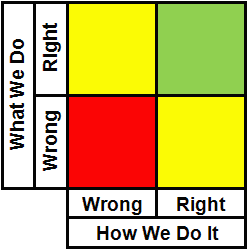
Pretty straightforward: everything can be placed in one of these four quadrants. We are either doing the right things or the wrong things. We are either doing them well or poorly. In contrast to all the complicated governance models that are being bandied about these days, this is a simple way to run your IT shop, your business, and your life.
As an eye-opening exercise, take all the major business processes in your company and place them in this grid. We all like to think that we live in the upper right, doing the right things the right way. In reality, way too much of our world is in the lower left. Every business has outdated business practices, ancient processes, and needless bureaucratic overhead, firmly entrenched in horrifically bad tools and mechanisms.
It is not hard to find these “red” processes and set out to fix them. Ideally, we seek to push them to the up and to the right, into the land of “green” processes: the right things, done right. More often than not, we wind up just moving to the right, or just moving up. That’s certainly a better spot, but only as a resting point, not as a final destination.
Doing the wrong things right is often known as “paving cowpaths.” Some awful business processes are so entrenched that they cannot be rooted out. Discretion being the better part of valor, we choose to automate bad processes, throwing good technology at a bad system. Life does get better, but you’re still left with a bad process.
Doing the right things wrong is a little better. By eliminating the bad process, you’re much better positioned to ultimately do the right thing the right way. If you wind up stalled on the way to the upper right, I’d rather be in the “right things wrong” world instead of the “wrong things right” world.
It’s easy to understand why. Technology is easy; people are hard. The worst part of our jobs is the social engineering: getting people to change their ways, adopt new practices, and learn new tools. Actually installing a new system can be a pain, but it can be done. People, with their delightful quirky personalities, pose real challenges to change and growth. If you move a process to the right, you’re still stuck with the difficult people problem. If you move a process up, you’ve solved the people problem and are left with the simpler technology concerns.
It is often said that managers get things done right, while leaders get the right things done. On our chart, good managers push things to the right. Good leaders push things up. Are you a manager or a leader? Which way are you pushing?
Why Are You Here? February 27, 2009
Posted by Chuck Musciano in Leadership.Tags: Coaching, Leadership, Mentor
3 comments
One of favorite quotes is from Ashleigh Brilliant:
It could be that the purpose of your life is only to serve as a warning to others.
This quote has been immortalized in one of the delightful Demotivator posters, many of which I find endlessly amusing. Amusing or not, these posters provide many good lessons in leadership in a very backhanded way.
In a recent email exchange, I was reminded that although I have learned a lot from several good leaders for whom I worked, I usually learned the most from the very bad leaders under whom I suffered. Some people can share heartwarming stories of good leaders whose words and actions served to inspire them. Everyone can recount endless stories of incredible abuse from thoughtless fools who were somehow given a leadership role in spite of their clear sociopathic tendencies.
I worked for one person who honestly epitomized every bad leadership quality you could imagine. He punished in public and praised in private. He never communicated. His ego knew no bounds. He sold out his people for his own gain. He took credit when things went well and threw us under the bus when they went badly. He would change projects, schedules, plans, and goals at the drop of a hat. Even when confronted with direct feedback in a group review, he simply ignored it and thanked everyone for their honesty. He was, in short, an idiot of spectacular dimension.
With each error, each annoyance, each dig and snub, I added to my mental list of “things I will never do when I am in charge.” I came away with more ideas on how to be a good leader than I ever thought possible.
It’s a sad fact of human nature that we often remember punishment more than praise. Eat bad food once and you’ll never touch it again, but the memories of a good meal do fade with time.
Don’t misunderstand: I am not suggesting that you “speed mentor” your team with a bout of bad leadership. Continue to be a good leader, but with the knowledge that those lessons will take a longer time to sink in. Most importantly, avoid even a single example of bad leadership, because that negative experience will never be forgotten.
To open up the conversation a bit, what good bit of leadership do you remember? More interestingly, what’s the worst leadership example you retain on your list of “things you’ll never do as a leader?”
State Your Name February 25, 2009
Posted by Chuck Musciano in Random Musings.Tags: Caller ID, Communication, Phone
add a comment
There are many unsung heroes in the history of technology. Today, I’d like to salute Ted Paraskevakos, the inventor of Caller ID. Ted started working on Caller ID back in 1968. I cannot believe that 40 years have passed and we still have not erected a monument to him somewhere. I would have settled for a Bud Light Real Men Of Genius salute, but even that has not come to pass.
Caller ID converted the phone from something controlled by the caller to something I control. In olden days, you pretty much had to pick up the phone; you never know what lay at the other end. Good news or bad, you took your chances, and you often got stuck with some interminable sales call.
With Caller ID, I get to choose my conversations. Whether the goal is catching that important call or avoiding a bothersome caller, Caller ID puts us all in charge of our phones. In the past, this luxury was reserved to those with full-time personal assistants. Now, we are all in control of our phones.
Best of all, I can now completely avoid calls from people who insist on blocking their Caller ID information. When the phone rings and the display shows “Unknown,” there is only one course of action: dump the call to voice mail. Who in their right mind would take a call from someone who is intentionally hiding their identity prior to the call? Most telling, the vast majority of these callers never leave a message.
Long-time readers know that I am a big fan of YouMail, the personalized voice mail service for your cell phone. Among the many marvelous features of YouMail is the ability to detect and handle blocked Caller ID separately from your other calls. In my case, callers get a message telling them that I do not accept blocked calls, and that they need to call back with the Caller ID information exposed. The call is then dropped, without even giving the caller a chance to leave a message.
So, a word of advice to potential callers: show yourself. If I have time, I’ll usually take the call. But if you block your name, I guarantee that I will never take your call, at home, or work, on on my cell.
On the other hand, if “Ted Paraskevakos” ever shows up on my phone’s display, I will definitely take the call.
How Are Things At Home? February 23, 2009
Posted by Chuck Musciano in Technology.Tags: Customer Service, Interfaces, iPhone, Microsoft, Users
add a comment
You can divide the technology at any company into two areas: the enterprise stuff and the end user stuff. The enterprise stuff includes all the “heavy iron” in the data center: the servers, storage, networks, monitoring systems, databases, firewalls, and what not. This is the domain of the IT professional, where we get to do deep analysis and evaluation of technology, cost benefits, and strategic value. The user stuff includes everything a user touches: desktops, laptops, phones, email clients, web browsers, and PDAs. Our ability to manage this technology hinges less on technology and more on what happens outside of work, in the user’s home.
We all have early adopters in our organizations: people who try out new things at home, way before they are actively considered at work. (I suspect that most readers of this blog fall into that category). These people provide wonderful free evaluation services, figuring out what works (and what doesn’t) so that we can make better decisions for our companies.
These early adopters can make or break a product. Vista was killed in the business market in large part due to the early negative reactions from these leading-edge home users. Even though Microsoft made huge progress in improving Vista, that early stigma never wore off.
Microsoft learned their lesson. The early adopter feedback on Windows 7 is almost universally good. Not coincidentally, I’m beginning to pick up positive buzz from other IT executives about their plans for Windows 7. Give Microsoft credit: they don’t quit and keep trying until they get it right.
The iPhone is a different story. Users are adopting these devices at home and love them. They come to work and want to use them with enterprise email on our networks. Unfortunately, many IT people (myself included) do not believe the iPhone is secure and manageable enough for corporate use. As a result, we’ve got a lot of cranky users who can’t use their iPhones at work. While this provides an opportunity to teach people about security and systems management, it still leaves users feeling disappointed.
Gone are the days when corporate IT led the way in bringing technology to the masses. Now we are followers, led by the consumer market and ever-more-savvy end users. To be successful and to stay ahead of the curve, we need to pay attention to what our users are doing and constantly ask them “How are things at home?”


 The Effective CIO