Bring It! March 23, 2009
Posted by Chuck Musciano in Leadership.Tags: Best Of 2009, Leadership, Management Skills, Problems
6 comments
My people bring me their problems. If you are in a leadership role, I’m guessing that your people bring you their problems, too. That seems natural. After all, we got to where we are by solving problems. We should be pretty good at this by now; it’s what we get paid to do.
Or is it? While solving the problems that arrive is certainly helping our organization, it is not helping the person who brought the problem. All things considered, solving the problem is actually harming the person who has come knocking on your door.
From the employee’s perspective, pushing a problem up the ladder is the easy way out. By definition, the boss will pick the solution that suits him or her, so you can’t lose brownie points by presenting the wrong answer. It saves you a lot of time trying to figure out the right answer, which is efficient. And you might learn something when you see how the boss would solve things.
Lesser leaders love it when people bring them problems to solve. It strokes their ego to know that they are the only one who can save the day. They get to show off their knowledge and skills when they provide the answer. They get to feel like they have taught a valuable lesson to the employee.
Better leaders know better. Our job as leaders is to teach and guide our employees to find the solutions on their own. The process of considering and rejecting alternatives is crucial to mentoring people to become better at what they do. Much like giving a man a fish instead of teaching him to fish, the issue is resolved but nothing is gained.
As a leader, this is really hard to do. Our natural inclination is to solve the problem and move on. It is contrary to our nature to push the problem back to the employee and see what they might do. But this is exactly what we must do, every time this happens.
My team learned long ago that I expect them to come to me with a problem and a solution. With a proposed solution on the table, we can debate the merits, consider alternatives, and arrive at the right answer together. Hopefully, they learn something as we find that answer.
Invariably, when someone brings me a problem, my first question to them is, “What do you think we should do?” If they can’t answer, they need to go away and come back when they have a proposal to consider.
Note that this advice applies to you when you go to your boss: bring the problem and your solution. At our level, you are seeking consensus on your approach, not a quick answer to hard problems. Your boss may able to provide political advice and other intangible support; you need to bring the real answer.
Practice what your preach and apply this rule consistently. Over time, your people will become better problem-solvers without being dependent on you for all the answers. Then you will have achieved your real goal as a leader: mentoring your people to be better than you at everything they do, and then simply getting out of their way.
Right Or Wrong? Well or Poorly? March 2, 2009
Posted by Chuck Musciano in Leadership.Tags: Best Of 2009, Governance, Leadership, Management Skills, Project Management
5 comments
In a previous life, my boss had this chart hanging on his wall:
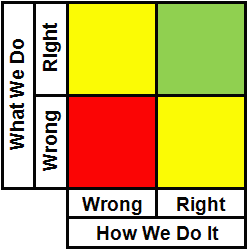
Pretty straightforward: everything can be placed in one of these four quadrants. We are either doing the right things or the wrong things. We are either doing them well or poorly. In contrast to all the complicated governance models that are being bandied about these days, this is a simple way to run your IT shop, your business, and your life.
As an eye-opening exercise, take all the major business processes in your company and place them in this grid. We all like to think that we live in the upper right, doing the right things the right way. In reality, way too much of our world is in the lower left. Every business has outdated business practices, ancient processes, and needless bureaucratic overhead, firmly entrenched in horrifically bad tools and mechanisms.
It is not hard to find these “red” processes and set out to fix them. Ideally, we seek to push them to the up and to the right, into the land of “green” processes: the right things, done right. More often than not, we wind up just moving to the right, or just moving up. That’s certainly a better spot, but only as a resting point, not as a final destination.
Doing the wrong things right is often known as “paving cowpaths.” Some awful business processes are so entrenched that they cannot be rooted out. Discretion being the better part of valor, we choose to automate bad processes, throwing good technology at a bad system. Life does get better, but you’re still left with a bad process.
Doing the right things wrong is a little better. By eliminating the bad process, you’re much better positioned to ultimately do the right thing the right way. If you wind up stalled on the way to the upper right, I’d rather be in the “right things wrong” world instead of the “wrong things right” world.
It’s easy to understand why. Technology is easy; people are hard. The worst part of our jobs is the social engineering: getting people to change their ways, adopt new practices, and learn new tools. Actually installing a new system can be a pain, but it can be done. People, with their delightful quirky personalities, pose real challenges to change and growth. If you move a process to the right, you’re still stuck with the difficult people problem. If you move a process up, you’ve solved the people problem and are left with the simpler technology concerns.
It is often said that managers get things done right, while leaders get the right things done. On our chart, good managers push things to the right. Good leaders push things up. Are you a manager or a leader? Which way are you pushing?
When Vultures Circle January 21, 2009
Posted by Chuck Musciano in Random Musings.Tags: Best Of 2009, Decisions, Denial, Florida, Vultures
1 comment so far
I spent fifteen years living in Florida. While some people view Florida as an idyllic tropical paradise of surf, sand, and perky rodents, I see it more as a modern taste of biblical Egypt. While I left Florida before experiencing all ten plagues, I have actually lived through plagues of frogs, locusts, flies, and hail. Some modern plagues filled in for the traditional ones; a plague of boils sounds bad, but a plague of tourists can be overwhelming. Flash floods and brush fires are lovely, and you haven’t lived until you’ve discovered that a plague of wild pigs have uprooted your entire yard overnight.
I reached my tipping point one hot afternoon while trying to mow our yard. I recognize that “hot afternoon” translates to every day in Florida except for the tail end of January; this was actually a really hot day in August, with temperature and humidity both nearing 100.
The mower had broken down. I was sitting next to it surrounded by tools and mower parts, sweating and muttering. As I wondered if a plague of mower problems was just beginning, I heard a “whoosh.” An enormous vulture landed next to me, no more than three feet away!
Vultures are huge, ugly birds. Up close, they are even huger and uglier. They spend their days circling high above the Florida swamps, looking for dead things to eat. In my current state, I attracted enough vulture attention to warrant a further look. The vulture and I sat silently, considering each other. I could see, in his beady vulture eyes, the assessment occurring. “Hmmm. Not dead yet, but close. Could be dinner tonight; definitely dinner by tomorrow.”
Mental notes taken, he flapped his gigantic wings and took off, leaving me with my mower. I was relieved that I had not warranted an immediate taste, but deeply concerned by the perception of my imminent demise.
We had had enough of Florida. Soon after, we began looking for a new job and home, which has led to many wonderful things for me and my family. While the vulture was not the single reason for our leaving Florida, I still think of it as a strong motivating event for finally taking action and getting on with our move.
When faced with difficult, potentially costly decisions, I am reminded of the vulture. It was the sign that convinced me to get moving. In our personal and business lives, we often avoid hard decisions and try to defer the pain. Moving was hard, but staying in Florida would have been disastrous.
Sometimes, it takes a vulture to force the issue and get us moving. Are you avoiding a decision? Are you in denial about a looming change to your world? Do you need a vulture?


 The Effective CIO