A Greatly Needed Void March 25, 2009
Posted by Chuck Musciano in Leadership.Tags: Leadership, Management Skills
add a comment
Many years ago, an email circulated with clever lines from back-handed letters of “recommendation.” One brought a smile to my face and has stuck with me to this day:
He fills a greatly needed void.
What a perfect description of the deadwood in your organization!
Leaders often spend a lot of time worrying about the thin spots in their teams. These days, especially, we are all stretched thin and trying to keep things running with reduced staffs and resources. Without a deep bench, the loss of one or two key people could really be a problem for us. As a result, we focus on filling voids: plugging people into open positions to make sure that everything is covered. Those voids represent risk and exposure, and its our job to reduce both.
Perhaps we should spend a little more time looking to create some voids. While eliminating people is unpleasant and painful, our teams always benefit from a little housecleaning. Not only do you eliminate people that were not contributing, you improve the morale of those who were.
When people see that an organization will tolerate poor performance, they are less inclined to contribute. After all, if you can stay employed with less effort, why try harder? When you demonstrate that poor performance will not be tolerated, some borderline employees will get the message and pick up their pace a bit. Good employees will continue to work hard, knowing that good performance is expected and rewarded.
When did you last go looking for greatly needed voids in your organization? When did you last honestly assess each person in terms of their contribution, commitment, and character? Is a person harming your organization by squandering the privilege of working there? Is a person pulling others down to their level? Answer these questions honestly, and you’ll find a few needed voids.
Don’t overlook the most important void: are you filling one? Could you be perceived as lacking in contribution, commitment, or character? Are you able to objectively figure that out? I guarantee that the voids you seek in your team have no idea that they are in that position. Don’t be similarly blind.
Here’s hoping you’ll have the discernment to find the greatly needed voids in your organization and the courage to create them. And may you never find yourself filling a greatly needed void.
Bring It! March 23, 2009
Posted by Chuck Musciano in Leadership.Tags: Best Of 2009, Leadership, Management Skills, Problems
6 comments
My people bring me their problems. If you are in a leadership role, I’m guessing that your people bring you their problems, too. That seems natural. After all, we got to where we are by solving problems. We should be pretty good at this by now; it’s what we get paid to do.
Or is it? While solving the problems that arrive is certainly helping our organization, it is not helping the person who brought the problem. All things considered, solving the problem is actually harming the person who has come knocking on your door.
From the employee’s perspective, pushing a problem up the ladder is the easy way out. By definition, the boss will pick the solution that suits him or her, so you can’t lose brownie points by presenting the wrong answer. It saves you a lot of time trying to figure out the right answer, which is efficient. And you might learn something when you see how the boss would solve things.
Lesser leaders love it when people bring them problems to solve. It strokes their ego to know that they are the only one who can save the day. They get to show off their knowledge and skills when they provide the answer. They get to feel like they have taught a valuable lesson to the employee.
Better leaders know better. Our job as leaders is to teach and guide our employees to find the solutions on their own. The process of considering and rejecting alternatives is crucial to mentoring people to become better at what they do. Much like giving a man a fish instead of teaching him to fish, the issue is resolved but nothing is gained.
As a leader, this is really hard to do. Our natural inclination is to solve the problem and move on. It is contrary to our nature to push the problem back to the employee and see what they might do. But this is exactly what we must do, every time this happens.
My team learned long ago that I expect them to come to me with a problem and a solution. With a proposed solution on the table, we can debate the merits, consider alternatives, and arrive at the right answer together. Hopefully, they learn something as we find that answer.
Invariably, when someone brings me a problem, my first question to them is, “What do you think we should do?” If they can’t answer, they need to go away and come back when they have a proposal to consider.
Note that this advice applies to you when you go to your boss: bring the problem and your solution. At our level, you are seeking consensus on your approach, not a quick answer to hard problems. Your boss may able to provide political advice and other intangible support; you need to bring the real answer.
Practice what your preach and apply this rule consistently. Over time, your people will become better problem-solvers without being dependent on you for all the answers. Then you will have achieved your real goal as a leader: mentoring your people to be better than you at everything they do, and then simply getting out of their way.
Chaos As A Service March 13, 2009
Posted by Chuck Musciano in Leadership.Tags: Chaos, Leadership, Software, Software As A Service, Technology
2 comments
I recently worried about the potential disconnect between users seeking the latest technology and IT leaders being able to successfully assist them in finding that technology. If we don’t gain the trust of users before they start buying solutions, they’ll acquire things that will hurt our companies and drive IT staff to distraction. This all happens with the best of intentions, but is a disaster nonetheless.
Traditionally, buying technology solutions was a complicated affair. Not only did you have to buy software, you usually had to buy the servers and infrastructure that would host that software. The complexity of the purchase invariably allowed IT to get involved before the purchase was a done deal. If nothing else, the size of the purchase would raise flags, and the integration of the solution involved a call to someone, somewhere, who would know how to run the system.
With the arrival of Software As A Service (Saas), technology acquisition is frighteningly simple. The infrastructure is hosted in the cloud, so users need not worry about buying heavy iron to run their new applications. The pricing is typically by the month and builds incrementally, so that the initial outlay is so low that no one notices. Most of these apps run within a browser, so users are up and running quickly.
Proponents of Saas point to these features as the core value of Saas. No longer shackled by the restrictive concerns of centralized IT organizations, users are free to find and buy whatever tools suit their needs. This makes users more effective and efficient, and we all benefit. Right?
Wrong! Unbeknownst to the user community, there is a method to the madness of a good IT shop. Believe it or not, people spend a lot of time making sure that all these tools and systems work together and share information to maximize their value. They also worry about tiny details like backups, security, business continuity, and disaster recovery. In some cases, annoying distractions like the SEC and government regulations affect how we integrate and manage systems.
When many users independently acquire many tools, the ability to integrate and manage those tools effectively disappears. While you may achieve some local optimization for a small group of users, you have eliminated any ability to achieve enterprise-wide integration and sharing. The value in our information systems is ensuring that accurate, complete information is delivered to the right person at the right time. If that information is smeared across independent external systems, tying it all back together is simply impossible.
Unfortunately, Saas is sold like snake oil to unsuspecting end users. Before anyone knows what has happened, users can go to a web site, sign up for a service, and start using it. Once entrenched, that service is hard to eliminate or replace, and IT plays catch-up trying to extract and integrate the data in the system with the rest of the company. The cost is enormous and the user irritation is high.
Don’t misunderstand: Saas has value and can provide a cost-effective way to outsource part or all of your IT infrastructure. But the acquisition of Saas solutions is no different from a traditional system running on your own servers. It must integrate and comply with your strategic enterprise architecture, along with all your policies on disaster recovery, security, document retention, etc. Appropriate IT scrutiny of Saas before the purchase leads to clean integration and happy users.
How do you make this happen? The same way every IT success occurs: good communication with users that builds trust and natural partnerships to find solutions. Start talking and serving users now, and you’ll avoid chaotic Saas acquisitions later.
Right Or Wrong? Well or Poorly? March 2, 2009
Posted by Chuck Musciano in Leadership.Tags: Best Of 2009, Governance, Leadership, Management Skills, Project Management
5 comments
In a previous life, my boss had this chart hanging on his wall:
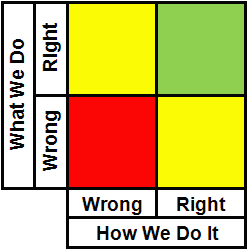
Pretty straightforward: everything can be placed in one of these four quadrants. We are either doing the right things or the wrong things. We are either doing them well or poorly. In contrast to all the complicated governance models that are being bandied about these days, this is a simple way to run your IT shop, your business, and your life.
As an eye-opening exercise, take all the major business processes in your company and place them in this grid. We all like to think that we live in the upper right, doing the right things the right way. In reality, way too much of our world is in the lower left. Every business has outdated business practices, ancient processes, and needless bureaucratic overhead, firmly entrenched in horrifically bad tools and mechanisms.
It is not hard to find these “red” processes and set out to fix them. Ideally, we seek to push them to the up and to the right, into the land of “green” processes: the right things, done right. More often than not, we wind up just moving to the right, or just moving up. That’s certainly a better spot, but only as a resting point, not as a final destination.
Doing the wrong things right is often known as “paving cowpaths.” Some awful business processes are so entrenched that they cannot be rooted out. Discretion being the better part of valor, we choose to automate bad processes, throwing good technology at a bad system. Life does get better, but you’re still left with a bad process.
Doing the right things wrong is a little better. By eliminating the bad process, you’re much better positioned to ultimately do the right thing the right way. If you wind up stalled on the way to the upper right, I’d rather be in the “right things wrong” world instead of the “wrong things right” world.
It’s easy to understand why. Technology is easy; people are hard. The worst part of our jobs is the social engineering: getting people to change their ways, adopt new practices, and learn new tools. Actually installing a new system can be a pain, but it can be done. People, with their delightful quirky personalities, pose real challenges to change and growth. If you move a process to the right, you’re still stuck with the difficult people problem. If you move a process up, you’ve solved the people problem and are left with the simpler technology concerns.
It is often said that managers get things done right, while leaders get the right things done. On our chart, good managers push things to the right. Good leaders push things up. Are you a manager or a leader? Which way are you pushing?
Why Are You Here? February 27, 2009
Posted by Chuck Musciano in Leadership.Tags: Coaching, Leadership, Mentor
3 comments
One of favorite quotes is from Ashleigh Brilliant:
It could be that the purpose of your life is only to serve as a warning to others.
This quote has been immortalized in one of the delightful Demotivator posters, many of which I find endlessly amusing. Amusing or not, these posters provide many good lessons in leadership in a very backhanded way.
In a recent email exchange, I was reminded that although I have learned a lot from several good leaders for whom I worked, I usually learned the most from the very bad leaders under whom I suffered. Some people can share heartwarming stories of good leaders whose words and actions served to inspire them. Everyone can recount endless stories of incredible abuse from thoughtless fools who were somehow given a leadership role in spite of their clear sociopathic tendencies.
I worked for one person who honestly epitomized every bad leadership quality you could imagine. He punished in public and praised in private. He never communicated. His ego knew no bounds. He sold out his people for his own gain. He took credit when things went well and threw us under the bus when they went badly. He would change projects, schedules, plans, and goals at the drop of a hat. Even when confronted with direct feedback in a group review, he simply ignored it and thanked everyone for their honesty. He was, in short, an idiot of spectacular dimension.
With each error, each annoyance, each dig and snub, I added to my mental list of “things I will never do when I am in charge.” I came away with more ideas on how to be a good leader than I ever thought possible.
It’s a sad fact of human nature that we often remember punishment more than praise. Eat bad food once and you’ll never touch it again, but the memories of a good meal do fade with time.
Don’t misunderstand: I am not suggesting that you “speed mentor” your team with a bout of bad leadership. Continue to be a good leader, but with the knowledge that those lessons will take a longer time to sink in. Most importantly, avoid even a single example of bad leadership, because that negative experience will never be forgotten.
To open up the conversation a bit, what good bit of leadership do you remember? More interestingly, what’s the worst leadership example you retain on your list of “things you’ll never do as a leader?”


 The Effective CIO