Bring It! March 23, 2009
Posted by Chuck Musciano in Leadership.Tags: Best Of 2009, Leadership, Management Skills, Problems
6 comments
My people bring me their problems. If you are in a leadership role, I’m guessing that your people bring you their problems, too. That seems natural. After all, we got to where we are by solving problems. We should be pretty good at this by now; it’s what we get paid to do.
Or is it? While solving the problems that arrive is certainly helping our organization, it is not helping the person who brought the problem. All things considered, solving the problem is actually harming the person who has come knocking on your door.
From the employee’s perspective, pushing a problem up the ladder is the easy way out. By definition, the boss will pick the solution that suits him or her, so you can’t lose brownie points by presenting the wrong answer. It saves you a lot of time trying to figure out the right answer, which is efficient. And you might learn something when you see how the boss would solve things.
Lesser leaders love it when people bring them problems to solve. It strokes their ego to know that they are the only one who can save the day. They get to show off their knowledge and skills when they provide the answer. They get to feel like they have taught a valuable lesson to the employee.
Better leaders know better. Our job as leaders is to teach and guide our employees to find the solutions on their own. The process of considering and rejecting alternatives is crucial to mentoring people to become better at what they do. Much like giving a man a fish instead of teaching him to fish, the issue is resolved but nothing is gained.
As a leader, this is really hard to do. Our natural inclination is to solve the problem and move on. It is contrary to our nature to push the problem back to the employee and see what they might do. But this is exactly what we must do, every time this happens.
My team learned long ago that I expect them to come to me with a problem and a solution. With a proposed solution on the table, we can debate the merits, consider alternatives, and arrive at the right answer together. Hopefully, they learn something as we find that answer.
Invariably, when someone brings me a problem, my first question to them is, “What do you think we should do?” If they can’t answer, they need to go away and come back when they have a proposal to consider.
Note that this advice applies to you when you go to your boss: bring the problem and your solution. At our level, you are seeking consensus on your approach, not a quick answer to hard problems. Your boss may able to provide political advice and other intangible support; you need to bring the real answer.
Practice what your preach and apply this rule consistently. Over time, your people will become better problem-solvers without being dependent on you for all the answers. Then you will have achieved your real goal as a leader: mentoring your people to be better than you at everything they do, and then simply getting out of their way.
Right Or Wrong? Well or Poorly? March 2, 2009
Posted by Chuck Musciano in Leadership.Tags: Best Of 2009, Governance, Leadership, Management Skills, Project Management
5 comments
In a previous life, my boss had this chart hanging on his wall:
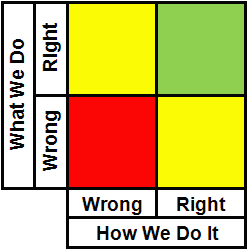
Pretty straightforward: everything can be placed in one of these four quadrants. We are either doing the right things or the wrong things. We are either doing them well or poorly. In contrast to all the complicated governance models that are being bandied about these days, this is a simple way to run your IT shop, your business, and your life.
As an eye-opening exercise, take all the major business processes in your company and place them in this grid. We all like to think that we live in the upper right, doing the right things the right way. In reality, way too much of our world is in the lower left. Every business has outdated business practices, ancient processes, and needless bureaucratic overhead, firmly entrenched in horrifically bad tools and mechanisms.
It is not hard to find these “red” processes and set out to fix them. Ideally, we seek to push them to the up and to the right, into the land of “green” processes: the right things, done right. More often than not, we wind up just moving to the right, or just moving up. That’s certainly a better spot, but only as a resting point, not as a final destination.
Doing the wrong things right is often known as “paving cowpaths.” Some awful business processes are so entrenched that they cannot be rooted out. Discretion being the better part of valor, we choose to automate bad processes, throwing good technology at a bad system. Life does get better, but you’re still left with a bad process.
Doing the right things wrong is a little better. By eliminating the bad process, you’re much better positioned to ultimately do the right thing the right way. If you wind up stalled on the way to the upper right, I’d rather be in the “right things wrong” world instead of the “wrong things right” world.
It’s easy to understand why. Technology is easy; people are hard. The worst part of our jobs is the social engineering: getting people to change their ways, adopt new practices, and learn new tools. Actually installing a new system can be a pain, but it can be done. People, with their delightful quirky personalities, pose real challenges to change and growth. If you move a process to the right, you’re still stuck with the difficult people problem. If you move a process up, you’ve solved the people problem and are left with the simpler technology concerns.
It is often said that managers get things done right, while leaders get the right things done. On our chart, good managers push things to the right. Good leaders push things up. Are you a manager or a leader? Which way are you pushing?
Can You Fix This? January 30, 2009
Posted by Chuck Musciano in Leadership.Tags: Customer Service, Gadgets, Leadership, Management Skills
3 comments
I’m a gadget guy. I’ve been fascinated by things with blinking lights for a long time. Before I had access to computers, I built Heathkit radios. Before that, Erector sets and Legos. I love to tinker and figure out how things work. It led me to computing, which has led to great happiness in my career.
I think technical expertise makes me an effective CIO when I deal with other IT people, especially on my own team. I know enough to hold my own in technical discussion, and bring a lot of experience to the table as we try to design new systems and solve problems. I think a non-technical CIO can be easily overrun by their people and make bad decisions.
But does all that technical expertise make me an effective CIO among other executives? My management peers turn to me to solve quick problems with their phones, PDAs, and laptops. I get asked for advice on televisions and home networking. I never turn down such requests, if for no other reason than that it would be rude to refuse to help anyone. But I worry that such help pigeonholes me (and other technical CIOs) as the nerdy A/V guy, forever destined to set up the projector and advance the filmstrip during class.
CIOs have fought hard to get real management visibility and recognition. But we cannot ignore our technical roots. We have to strike a balance between our business skills and our technical skills. Done right, we retain our management focus while bringing technical perspective to the discussion at hand. Done poorly, we forever lose credibility among our peers.
Every CIO should seek to be seen as a good business leader with technology skills, not as a technology provider who happens to know a bit about business. Sometimes, the only way to reinforce that perception is to let someone else set up the projector.
Snips and Snails and Puppydog Tails April 16, 2008
Posted by Chuck Musciano in Leadership.Tags: Best Of 2008, Management Skills
add a comment
Apparently, little boys (and little girls, for that matter) were figured out long ago, content-wise. CIOs, in contrast, seem to be in a state of constant flux.
As you climb the management ladder in IT, you remove yourself from the technology that attracted you to the field in the first place. Your time is increasingly occupied with issues that allow your company to use information technology to further its business. By the time you reach the top of the chain, your staff wouldn’t let you near a machine with a ten foot pole. I have a notorious reputation as a Breaker Of Things; my staff visibly tenses up when I make the occasional foray into the data center to reconnect with blinking lights and cold air.
Given this career transition, what are CIOs made of? My recipe: 40% accountant, 40% attorney, and 20% psychologist. Here’s why:
- Accountant: Good CIOs focus on business value. Each company may have different ways to measure business value, but in the end it is a financial metric, not a technical one. Moreover, the language of business is financial. To have a credible leadership presence in your company, you must be able to translate technology into financial terms. Sometimes those terms are in hard-dollar returns; in other cases it may be in terms of business advantage, time to market, process enhancement, or other fundamentally financial metrics. If terms like EBITDA, GAAP, and SOX aren’t part of your vocabulary, or you can’t explain when to use expense versus capital dollars, you may be falling short in this area.
- Attorney: Good CIOs know how to negotiate and close a deal. Vendor management largely revolves around good contractual management. You need the basic legal skills to understand contractual terms, assess liability, and understand how to build solutions that protect your company from a legal perspective. So much of what IT confronts these days is about compliance, exposure, and risk management. You must be able to work in this world comfortably. CIOs may also be called upon to be deposed on behalf of their company and should understand the basics of litigation and representation.
- Psychologist: When things go bad and systems unravel, CIOs may find themselves talking everyone else down from the ledge. Technology is a great mystery to almost everyone; when it falls apart, you must be able to lead people to a stable solution. Increasingly, the projects we sponsor are technologically straightforward (install a new reporting system) but socially difficult (and make everyone give up their existing personal spreadsheets). This kind of social engineering can be quite rewarding but requires deft people skills and the ability to see the world through your users’ eyes.
This isn’t to say that you can forget your technology roots. Inside your organization, you need the technical chops to evaluate solutions, challenge your people, and be able to hold your own in the occasional hallway debate. CIOs lacking business skills will fail outside their organization; CIOs lacking technical skills will fail inside their organization.


 The Effective CIO