Goodbye, Roy February 11, 2008
Posted by Chuck Musciano in Random Musings.Tags: Acting, Movies, Roy Schieder
add a comment
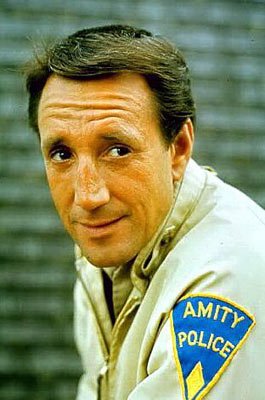 Roy Scheider passed away this weekend at the age of 75, after battling cancer for two years. He is famous, of course, for playing Police Chief Martin Brody in Jaws, as well as starring in dozens of other films. And, although it seems to have been overlooked in his various obituaries, he also starred in a movie with me.
 , as well as starring in dozens of other films. And, although it seems to have been overlooked in his various obituaries, he also starred in a movie with me.
In parallel with my lengthy IT career, I also moonlighted as a movie extra back in the ’80s. For the princely sum of $40 a day (less $4 to my agent) my acting services were available to any and all production companies choosing to film in the Orlando area. Over a period of several years, I performed in Disney travel videos, commercials, and training and marketing films known as “industrials.” I got to meet Michael Eisner, and I even danced in close proximity to Downtown Julie Brown, which qualifies as my only foray into the horror genre.
My career peaked with my performance with Roy in Somebody Has To Shoot The Picture. In this film, a wrongly convicted man awaits his fate on death row while Roy attempts to exonerate him before it is too late. Not to spoil it or anything, but Roy just a bit too late and the man is executed, a dramatic indictment of our inherently unfair criminal justice system.
I appear in the very, very, very last scene of the movie. As Roy walks out of the prison, head down and dejected, I can be seen with some other woman and two nuns, kneeling in prayer beside the walkway. Roy walks right next to me as the credits start to roll.
We shot this scene at night, and it took all night to get it right. We spent a lot of time hanging out at the caterer’s cart, feasting on the excellent free food. As the shoot dragged on, the writer of the movie, an authentic Left Coast Liberal, polled the crowd of extras to see if we agreed with his political views. When he asked how many people on the set opposed the death penalty, not a single hand went up. This was at a time when Florida was trying to execute Ted Bundy for his serial killing spree, and also trying to legislate a mandatory seat belt law. T-shirts emblazoned with “I’ll buckle up when Bundy does” were popular. The poor writer had no idea of the kind of crowd he was up against. For $40, of course, we could set aside our political differences and act like we opposed the death penalty. Remember, there are no small parts, only small actors.
In hindsight, I realize now that shooting movies is a lot like most any IT project. It takes a lot longer than you originally estimated. It takes a lot more people and equipment that you originally thought. You’ll be up all night at some point. You have to do some parts over and over. And the most important aspect of the project is the quality of the free food they provide.
Too-Thin Mints February 9, 2008
Posted by Chuck Musciano in Random Musings.Tags: Health
add a comment
It is that time of year. Girl Scout Cookie time. That one time of year when the Thin Mints are so fresh, so fragrant, so irresistibly delicious.
 But this year is different. This year, Thin Mints (and all the other Girl Scout Cookies) are trans-fat free. So they are presumably healthier and better for you. But, having just conducted my own personal taste test, they are not as good as the Thin Mints you have known and loved. They are a little less rich and a little more crumbly. They just aren’t as good, I’m afraid.
But, at the behest of some distant bureaucrat, the companies that make Thin Mints, with our best healthful interests at heart, have pulled out the wonderfully delicious trans-fats and replaced them with some other, lesser fats. Thin Mints may now be healthier, but they don’t taste as good, and we are all the worse off for that.
Let’s be honest: if your overall lifespan is affected by the number of Thin Mints you consume in your lifetime, you are eating way too many Thin Mints. And if you are eating that many Thin Mints, I’m guessing you may be overindulging in a lot of other high-risk foods, like cake, and fudge, and maybe even juicy, dripping, double chili-cheeseburgers. It’s not like someone spends their whole life suffering through a diet of tofu, bark, and organic lettuce and winds up dead from eating a sleeve or two of Thin Mints.
I also doubt that the initial assessment checklist in any Emergency Room includes an entry for total Thin Mints consumed to date. Has anyone ever seen someone lying on a gurney, fighting for their life, while their spouse sits beside them, bereft, twisting an empty Thin Mint box in their shaking hands? I didn’t think so.
The real issue here is freedom and self-determination. If I want to eat trans-fats (or not), that’s my choice. The Girl Scouts should be free to sell wonderful cookies drenched in trans-fats, and you can choose to buy them (or not). Even better, sell both kinds, and see which one prevails in the free market. Does anyone doubt which way that taste test would go? I’d pay extra for a box of Thin Mints with a big “Made With 100% Trans-Fat!” sticker emblazoned on the front.
Getting Away February 6, 2008
Posted by Chuck Musciano in Leadership.Tags: Strategy
add a comment
As much as I love my job (and I really do love my job), it is good to get away from the day-to-day activity of the office and think big thoughts. I’m writing this in Reagan National Airport, waiting to fly home after just such a get-away.
In this case, I was attending a one-day seminar sponsored by the CIO Executive Board. They provide CIO-focused research and strategic advice, as well as opportunities to meet with other CIOs facing similar issues. Today, 15 of us met to talk about business engagement and fostering innovation. I know: pretty compelling stuff!
Subject matter aside, it is good to engage in these kinds of meetings. As one of the attendees put it, the sessions are part inspiration, part therapy. Executives at any level are often isolated from their peers; CIOs are no exception. Sometimes it is good to get together, share ideas, and commiserate. Isolated from the office and the constant pull of dozens of urgent issues, you get a chance to think at length about things and really put your thoughts in perspective.
While the topics at hand were interesting, my naturally short attention span allowed me to consider other topics throughout the day. Organizational issues, strategic planning, and technology challenges all seem clearer and easier to tackle after a day of reflection.
This kind of break is not uniquely suited to CIOs, of course, or even just C-level people. Everyone needs to get away every so often to consider the state of their world and how they plan to deal with their challenges. To do so in an environment with your peers, where you can bounce ideas around and see how others are doing things, makes it that much better. You come away feeling good about the things you are doing right, and with potential solutions to the things that you need to improve.
Unfortunately, we rarely schedule time for this kind of micro-sabbatical. Once I found myself working from home for a day while waiting for some repairman to show up. What a productive day! With laptop and cell phone at my side, I cleaned up all sorts of nagging issues, got ahead of a bunch of others, and came away feeling great. It made me wonder if we all should intentionally work in isolation once or twice a month just to boost our productivity.
All things considered, we should, and we should plan it well in advance to ensure that it will happen. There have been times in my career when I’ve had to block out time on my calendar just to work, ensuring that there would be no meetings to interrupt my time. Even now, I block out 8-9 AM every day just to start the day with time to get my world in order. I also set aside two hours every Thursday when I promise my team that I will be in my office, available for whatever they may need to discuss. These little oases of time make a big difference in maintaining my sanity and focus.
Time is precious, and focused time is invaluable. Intentionally setting aside time to focus and reflect is an important way to ensure that we stay effective and happy, no matter what we do for a living.
“You’ll Shoot Your Eye Out!” February 5, 2008
Posted by Chuck Musciano in Random Musings.Tags: Best Of 2008, Jean Shepherd, Writing
add a comment
These words have become part of our vernacular in America, the adult response that crushes the hopes and dreams of every kid who ever hoped to own a Red Ryder BB gun. They were made famous, of course, in the movie A Christmas Story, which has become an American holiday classic on a par with It’s A Wonderful Life and surpassing Miracle On 34th Street.
 The movie is based on the works of Jean Shepherd, weaving together a number of his best short stories with his childhood quest for the BB gun at the heart of the film. While millions have seen the film, far fewer have read his books on which it is based. And that’s a real shame.
On a whim, I recently dusted off In God We Trust, All Others Pay Cash and read it once again. And once again, I sat and laughed out loud at stories that I have enjoyed over and over since I first read them when I was 12. Jean Shepherd is perhaps the very best raconteur of the 20th century, with an ability to paint a picture with words that very few can match. His depth of vocabulary, his turn of a phrase, his cynical yet sweet style are just perfect. If you even remotely like the movie, by all means, buy and read his books.
In the 60s and 70s, Jean Shepherd had his own radio show on WOR out of New York. Each year, he would travel down to Princeton for a live performance during graduation week. My Dad and I would sit in a sweltering lecture hall packed with hundreds of other people and laugh until we cried. His timing and language were just superb. Everyone knew the stories, and knew how they would turn out. He knew we knew. And we still laughed until our sides hurt.
Many years later, while running the Unix data center for Harris Corporation, I began talking with Art Hayworth, one of the mainframe guys, about Jean Shepherd. I was astounded to discover that Art’s mother had been a fourth grade teacher in Hammond, Indiana (which became the fictional Hohmann in the book and movie) and had taught both Shepherd and his little brother Randy! Art had lived a few streets over from Cleveland Street, where Shepherd grew up. The fact that it was all real (sort of) made the stories all the more delicious.
Beyond the pure enjoyment I get from his stories, Jean Shepherd reaffirms for me the power of the written word. He wrote the stories in In God We Trust in the early ’60s. They describe his childhood during the Depression, but as I read them 45 years later, they evoke an image as real and compelling as the day he wrote them, or even when he actually lived them, 70 years ago. The movie, as good as it is, cannot come close to creating such an experience.
As we become immersed in broadband imagery, I fear we are letting go of words, with the best efforts of bloggers notwithstanding. At every level, success requires communication, and communication requires words. If you want to get really good at words, write them. Lots of them. And read lots of them, too. Starting with Jean Shepherd.
Trust But Verify January 29, 2008
Posted by Chuck Musciano in Leadership.Tags: Best Of 2008, Operations
1 comment so far
 I once worked in a company where the President had, in a former life, been a nuclear submarine commander. Needless to say, he had many fascinating stories. He also had an uncanny knack for uncovering the one thing that you had missed, or forgotten, or simply done wrong. When there was some sort of operational failure, he would methodically dig and dig until he uncovered the root cause. He then expected you to fix it, and then to implement some plan that would prevent the problem from ever happening again. Invariably, as he went about one of these rock-turning expeditions, he would repeat that fundamental rule: “You get what you inspect, not what you expect.”
A simple rule. Don’t assume that things are done correctly. Confirm, with your own eyes, that they really are right. Ask pointed questions. Look at logs. Pull on wires. Click things that aren’t supposed to be clicked. Make sure it really works, the way you understand it to work.
This makes a lot of sense when you are living in a submarine. One mistake in that environment, and hundreds of men die. Make a big mistake in a nuclear submarine and millions of people could die.
Working for someone with this philosophy can be frustrating. When my boss would come digging into my world, I would cringe and wait for the inevitable “aha!” moment. Over time I realized that the best way to avoid such moments was to adopt a similar attitude and find the problems before he did. I started doing my own inspecting, finding and fixing things before they became visible problems. Our operational metrics really improved. And the lesson had been passed on to another generation.
Obviously, you cannot inspect everything, all the time. But everything can be inspected, at some point, by someone. As a leader, you need to engage in enough inspection to ensure that your people, and their people, will be inspecting everything else. As they inspect more, and you come to trust their inspection, you’ll find yourself inspecting less. Much to their relief, I might add. But don’t ever stop inspecting entirely. The possibility of inspection is often enough to ensure appropriate attention to detail.
Unlike a nuclear submarine commander, most of us do not operate in a world where lives hang in the balance based on our operational decisions. But businesses do, and with them come customers, and employees, and shareholders, all relying on a small group of operations people to get it right, every time. Are you willing to bet your job on what you expect, or are you going to take the time to inspect your world?
I expect you will.


 The Effective CIO